
Lattice QCD
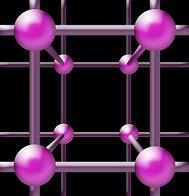
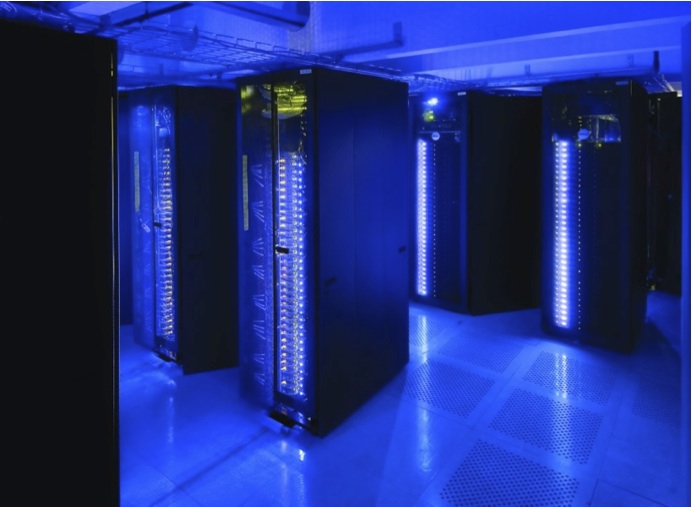
Quantum Chromodynamics (QCD) describes the interactions of quarks and gluons (by the force of Nature called the strong force) and predicts in principle the masses of their bound states (called hadrons). The calculation of hadron masses, however, can only be done by the numerical simulation of QCD on a lattice of space-time points. It is designated internationally as a "Grand Challenge" project, needing fast supercomputers. We use STFC's DiRAC High Performance Computing facility, in particular the powerful machine known as Darwin, pictured below, at the Cambridge High Performance Computing Service.
Research at Glasgow
Glasgow is part of the international HPQCD collaboration which includes teams from the UK (Glasgow, Cambridge and Plymouth), the USA, Canada and Spain. We have been leading progress worldwide in accurate calculations of hadron masses and their weak and electromagnetic decay rates. To do this we have developed a particularly good way of handling quarks on a space-time lattice called the Highly Improved Staggered Quark (HISQ) formalism. This enables us to include in our calculations the effect of energy fluctuations that create gluons and quark-antiquark pairs (sea quarks) allowing a fully realistic picture of the background strongly-interacting 'soup' in which the valence quarks that make up the hadron live.
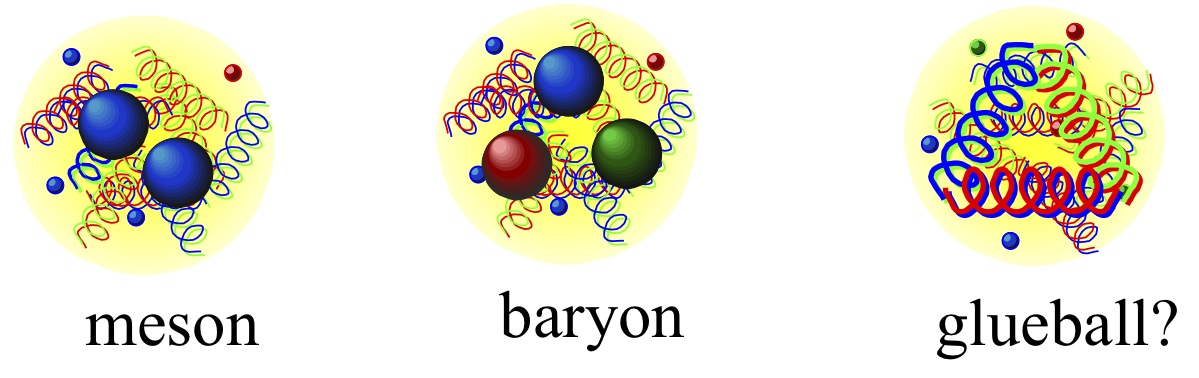
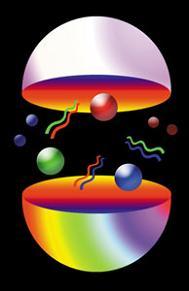
Quarks come in several different types or 'flavours', giving a whole zoo of hadrons when they are combined in different configurations. Known hadrons consist of mesons which have a quark and an antiquark as their principal or 'valence' quarks and baryons, which have as three valence quarks. In both cases the the valence quarks live in a background soup of strongly interacting gluons and a 'sea' of quark-antiquark pairs, as illustrated above. It may be possible that hadrons also exist which have no valence quarks being effectively a bound state of gluons known as glueballs. A very active experimental programme searching for these is in progress around the world.
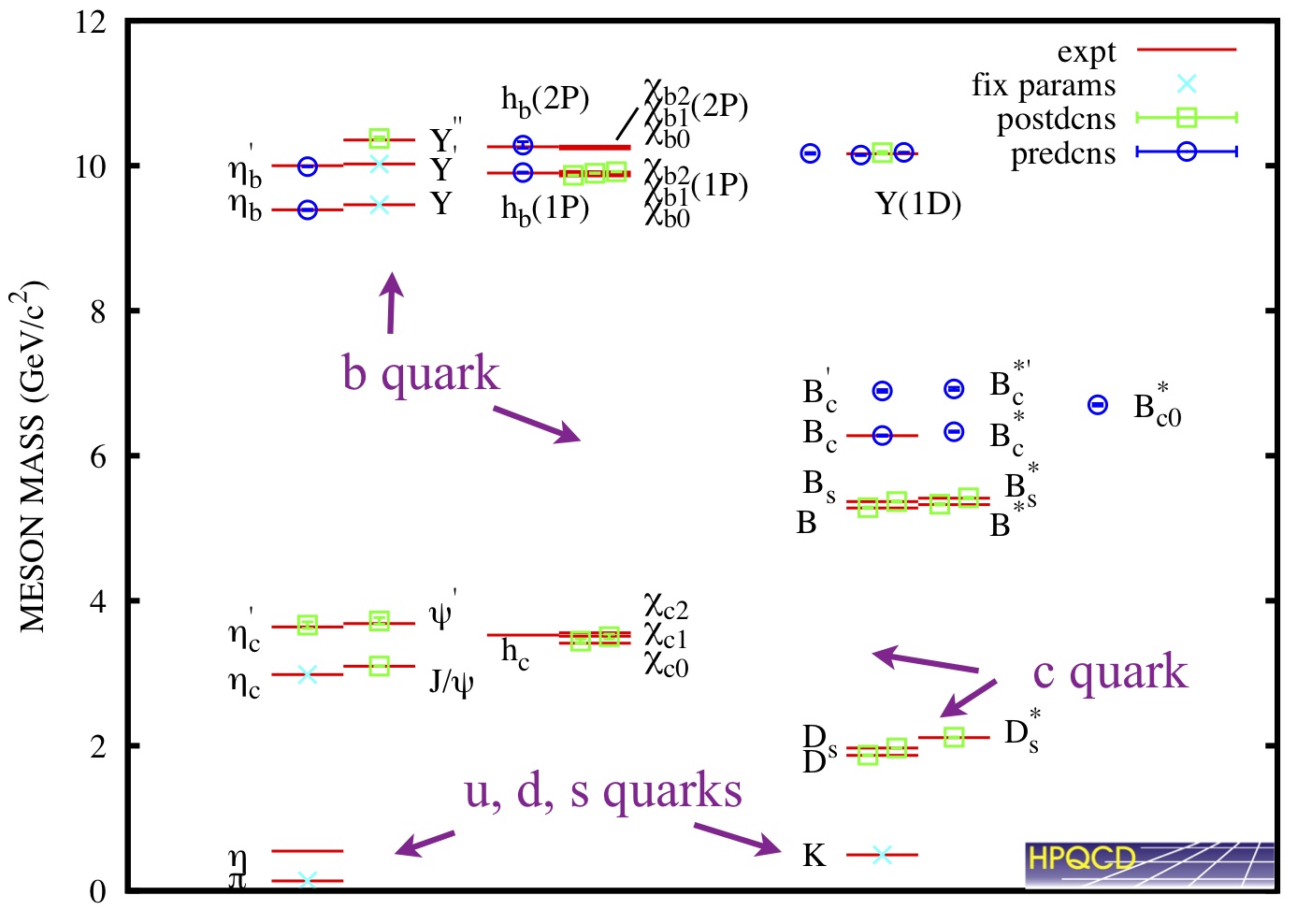
The masses of all of the hadrons are in principle calculable in QCD and it is important in lattice QCD to check against experiment for the full range of hadron physics. Below we show the spectrum of masses of 'gold-plated' mesons (those that are long-lived and therefore very accurately characterised in experiment) all the way from those containing the light up and down quarks through the intermediate mass strange and charm quarks to those containing the heavy bottom quarks. Our lattice QCD results are divided into those that are used to fix the parameters of QCD (for example the masses of the quarks), those where the calculation could be compared to existing experiment and those in which we were able to make a prediction ahead of experiment. These last are the most exciting calculations to do, and in some cases we have been able to get subsequent experimental confirmation of our results.
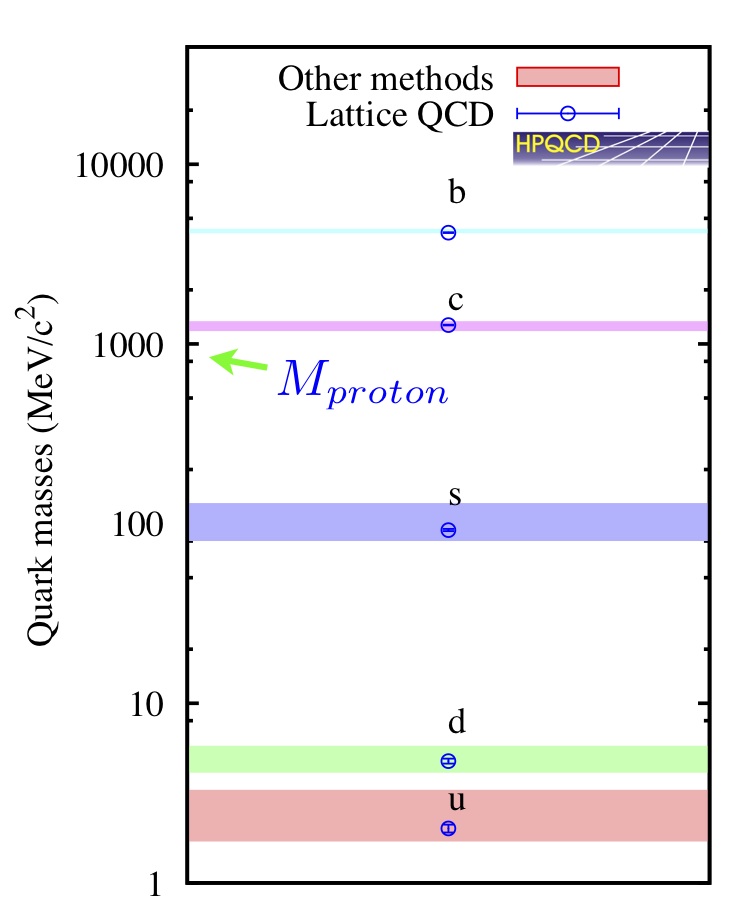
The fact that we are able to determine meson masses very accurately means in turn that we can determine accurately the parameters of QCD, i.e. the quark masses and the strong coupling constant which is the equivalent in QCD of the fine structure constant of electromagnetism. The figure on the left compares the results for the quark masses determined by us to that from other non-lattice QCD methods.
Recently we have improved our calculations further by including charm quarks in the sea and simulating up and down quarks with their physically very light masses. Earlier calculations had to extrapolate down from heavier masses because of the computational cost. This is allowing us to reduce errors further and look in more detail at a wider range of hadrons being studied by experiments at the Large Hadron Collider at CERN as well as facilities in China and Japan.
We are also determining decay rates, particularly of mesons containing charm and bottom quarks, relevant to searches for new physics worldwide. Further details are given in the section on heavy quarks.
Further Reading
Joining up the dots with the strong force Cover feature in CERN courier, June 2004.
Getting to Grips with the Strong Force, Physics World, August 2000, pp35-40.
New Scientist: Inside Science no. 63, World of Quarks, 10th July 1993.
Summer school lectures at the 55th Scottish Universities Summer School, St Andrews, August 2001. Suitable for graduate students in experimental or theoretical particle physics.