

The physics of heavy quarks with Lattice QCD
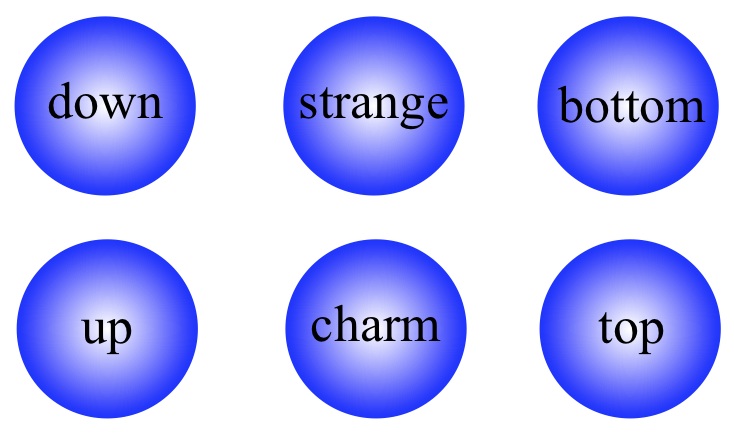
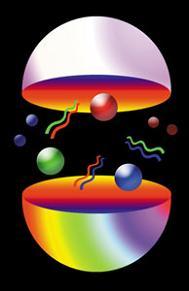
There are six different types, or "flavours", of quarks, known as up, down, strange, charm, bottom and top (see right). These form a "zoo" of hadrons, when bound together in different combinations (apart from the top quark, which decays too rapidly to form hadrons). Hadrons range from the "everyday" proton made from the light up and down quarks to the more exotic mesons made from the much heavier charm and bottom quarks, which are produced for an instant in a high energy collision ( for example at the Large Hadron Collider) and then decay to other hadrons, leaving tracks in the particle detectors from which their existence and properties can be inferred. In fact we never see free quarks so that all of the information we can obtain about them must come from the study of the properties of hadrons, combined with calculations using the theory of the strong interaction, Quantum Chromodynamics (QCD), that allows us to relate hadron properties to those of quarks. Mesons made from the relatively heavy charm and bottom quarks are particularly useful ones to study because they form a lot of hadrons whose properties can be accurately determined, allowing stringent tests of strong interaction physics. We, along with our colleagues in the HPQCD collaboration, have taken a lead in demonstrating the power of the numerical approach of lattice QCD, particularly to heavy quark physics. This has transformed our ability to make predictions in the Standard Model for key decay rates for mesons containing b quarks (for example the Bs meson decay to two muons) which are the focus of experiments at the Large Hadron Collider looking for new physics.
Research at Glasgow
We have been able to do impressive calculations for charm and bottom quarks because we have developed accurate methods for discretising the Dirac equation (including interaction with gluon fields) onto a space-time lattice. A particularly good discretisation is needed for heavy quarks because their shorter Compton wavelength makes them sensitive to the graininess of space-time introduced by working on a lattice. Our success with this has meant that we can calculate the masses of mesons containing b and c quarks with accuracies of a few MeV (see the full mass spectrum plot given in the lattice QCD section).
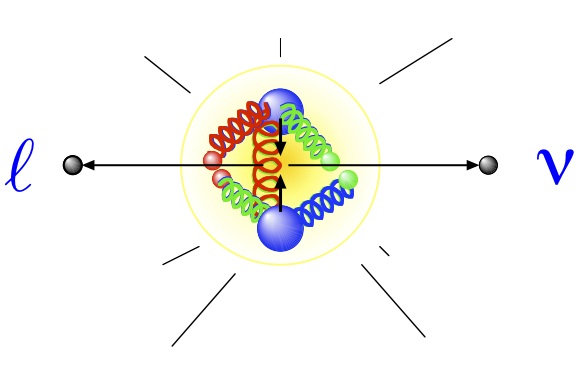
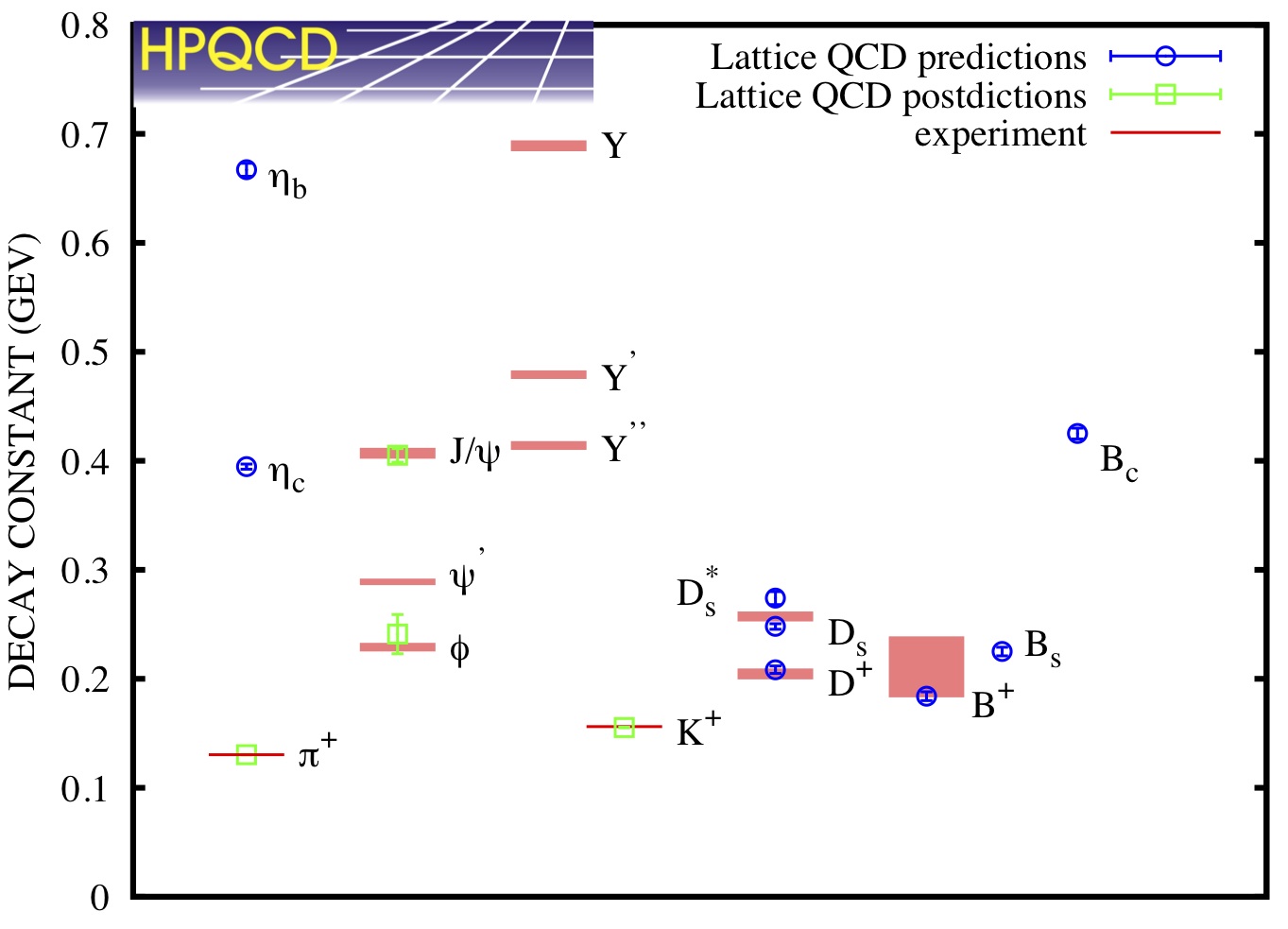
In the same calculation as that for the mass of a meson, we can calculate the amplitude for the quark and antiquark inside it to annihilate. This amplitude depends on all the QCD interactions that keep the quark and antiquark bound inside the meson and so must be calculated in lattice QCD. It is known as the decay constant of the meson. The annihilation process happens in Nature because quarks have electric charge (and so some mesons can decay to a photon) and also because quarks feel the weak interaction (and so some mesons can decay to a W boson of the weak force). Both of these kind of decay processes can be seen in experimental results and the rate measured. From the experimental results the decay constant can also be determined and a comparison between lattice QCD and experiment tests our understanding of the internal structure of mesons. A summary of our results compared to experiment is given below. Some results provide a 1% test of QCD. They also provide a test of our understanding of the weak interaction through the parameters in the Cabibbo-Kbayashi-Maskawa (CKM) matrix that give the couplings of different quarks to the W boson. Testing these parameters is a very active area of both theory and experiment, again in the hope of finding new physics, for example if the CKM matrix turned out not to be unitary.
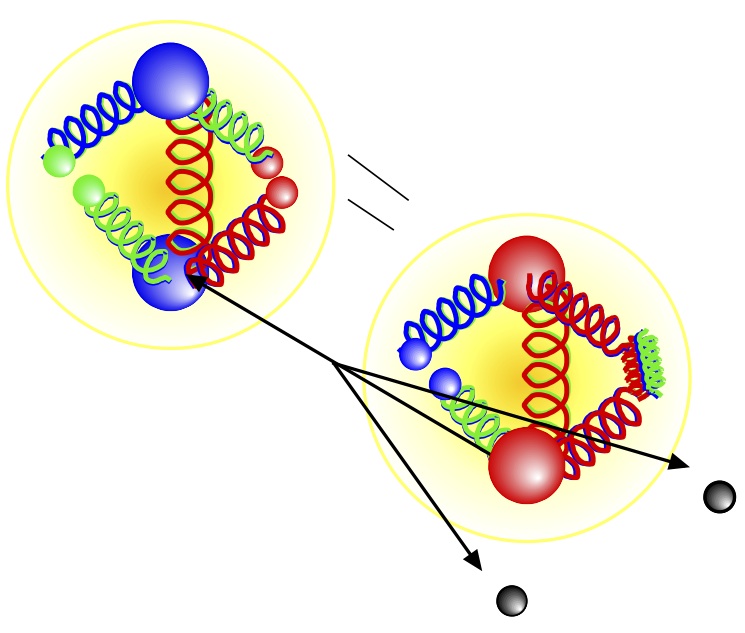
Further tests can be done through studies of transitions in which
a meson turns into another type of meson on emitting a W boson or a photon.
In this case, illustrated on the right, the quantity that encapsulates the information
in QCD about the internal structure of the meson is known as a form factor
and, instead of being just a single number, is a function of the square of
the 4-momentum transferred from the parent to the daughter meson.
We are calculating the form factors for a number of different processes ranging from the interaction of a pi meson with a photon (which determines the electric charge distribution inside a pi meson) to the decay of a D meson containing a charm quark to a K meson containing a strange quark. The latter case can be used both to determine the CKM matrix element Vcs to world-leading accuracy as well as to test the dependence of the form factor on q-squared against experiment. We are extending the range of form factors studied to include several new processes and we are now working with up and down quarks with their physically very light masses for the first time (instead of extrapolating down from heavier masses as previous calculations have done) to give much improved accuracy.
Further Reading
Joining up the dots with the strong force Cover feature in CERN courier, June 2004.
Getting to Grips with the Strong Force, Physics World, August 2000, pp35-40.
New Scientist: Inside Science no. 63, World of Quarks, 10th July 1993.
Summer school lectures at the 55th Scottish Universities Summer School, St Andrews, August 2001. Suitable for graduate students in experimental or theoretical particle physics.