External links
Research of the group
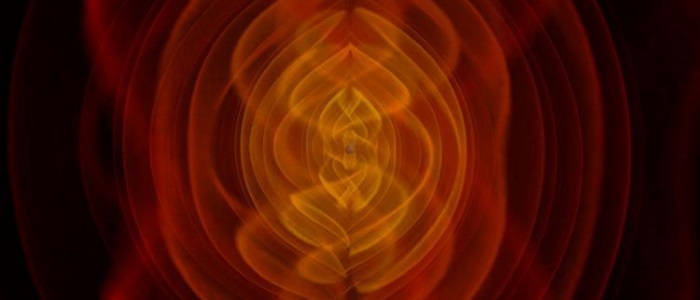
The work of this group, supported by STFC funding, is targeted at the development of detectors and signal analysis methods to search for gravitational waves from astrophysical sources. Gravitational waves - waves in the curvature of space-time - are a prediction of General Relativity. In recent years there has been considerable progress towards the detection of these waves. Indirect confirmation of their existence has come from observations of the orbital motion of the binary pulsar PSR 1913+16, for which work Hulse and Taylor were awarded the 1993 Physics Nobel Prize. This evidence and the recognition of its importance gave a significant boost to the efforts of physicists worldwide in the gravitational wave field. The group in Glasgow has been involved in both experimental development and data analysis for around 35 years.
Potential sources of gravitational waves include the coalescence of two compact stars such as neutron stars and/or black holes in binary systems and the collapse of massive stars in supernova explosions. The detection of these waves should give us unique new information about some of the most violent astrophysical processes in the universe. Detection techniques being developed at Glasgow and elsewhere rely on using laser interferometry to sense the minute changes (of order 10-18 m or less) induced by a gravitational wave in the relative separation of neighbouring test masses. In order to reach the sensitivity required to start making serious astrophysical observations, separations of kilometre-scale are required. Developments and operation of such long baseline detectors are currently being undertaken by several groups worldwide, including LIGO in the USA, VIRGO, a joint French/Italian collaboration, GEO 600 (Germany, UK) and TAMA 300 (Japan).
GEO 600 and LIGO
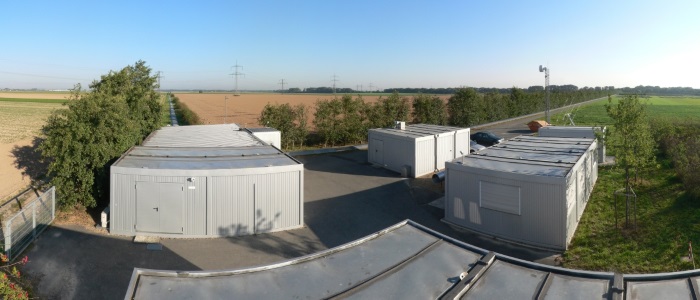
GEO 600 is a detector of arm length 600m, built in Hannover by a collaboration involving Glasgow, the University of Wales (Cardiff), the Albert-Einstein-Institute Hannover and the Albert Einstein Institute Golm. Although of shorter arm length than the LIGO or VIRGO detectors, GEO has some unique technical features that have enabled it to take part in a series of five major data taking runs with the larger detectors. These features include:
- quasi-monolithic fused silica suspensions of the test masses to allow a reduction in thermal noise
- the use of signal recycling - recycling of the signal sidebands on the output light back into the interferometer in a resonant way - to enhance signal size
The main areas focussed on by the Glasgow group are the development of precision novel interferometric techniques, and the development of systems of ultra low mechanical loss for the suspensions of mirror test masses. This latter area encompasses the development of multiple pendulum systems with the final stages using silica fibres for supporting the test masses. The group is also working on a novel bonding technology - hydroxy-catalysis bonding - which exhibits very low mechanical loss and is compatible with ultra high vacuum. To help with this work a JIF grant for the development of new laboratories, clean areas and interferometers was awarded to the group in 1999, and a Strategic Research Development Grant from the Scottish Funding Council in 2005, supporting the ongoing work of the IGR funded by STFC. These optical and mechanical technologies, as well as being used in GEO, are being transferred to the next 'Advanced' generation of the US laser interferometer system LIGO, and the GEO group is playing a crucial role in the development and construction of Advanced LIGO.
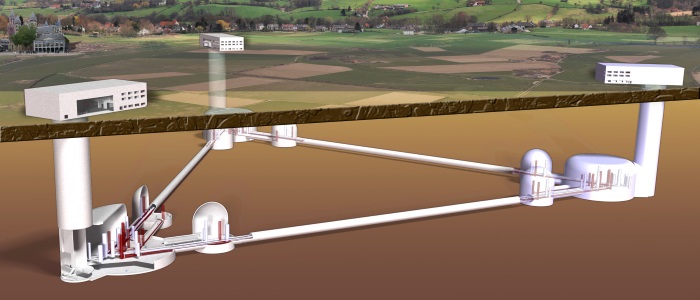
Advanced LIGO has been approved for construction by the National Science Board in the US. Glasgow, Birmingham and RAL, in collaboration with Strathclyde University are funded by STFC to supply the mirror suspensions and part of the optics for Advanced LIGO. The benefits of cooling to reduce noise in suspension systems is an area of research to be pursued over the next few years, and the group plays a leading part in a pan-European consortium carrying out a design study for a potential future '3rd generation' gravitational wave detector - the 'Einstein Telescope' - which may employ this, and other novel technologies.
LISA
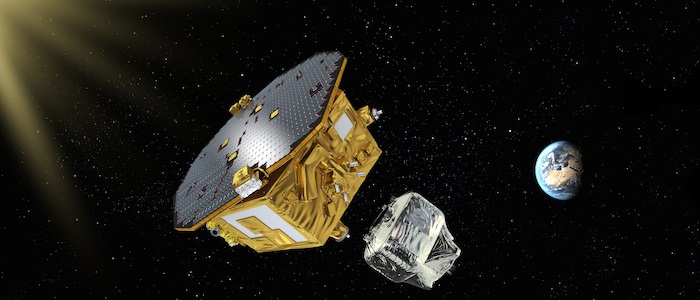
The Glasgow group are also involved in developments towards the space-based gravitational wave detector eLISA/NGO, which is an ESA mission potentially scheduled for launch around 2022. This detector will have comparable sensitivity to ground-based detectors, but in a completely different frequency range, and so will be able to explore a different region of the gravitational wave spectrum where signals from highly interesting sources such as massive black holes should be detectable. Glasgow work on lasers and interferometry for use in such space experiments was initially supported by an award of SHEFC New Initiative funding, was also greatly enhanced by the JIF award to us and has been further supported by STFC and ESA funding. Currently our group is committed to the development - under STFC funding - of the optical bench for LISA Pathfinder, a mission to demonstrate aspects of the drag free and interferometric technology for eLISA. This mission is due for launch in 2014.
Spin-off and related work
As well as its work in gravitational wave detectors, the Glasgow group works on applications of the hydroxy-catalysis bonding techniques for other experiments and projects in astronomy and space science.
A brief summary of our research can be found in this pdf flyer.